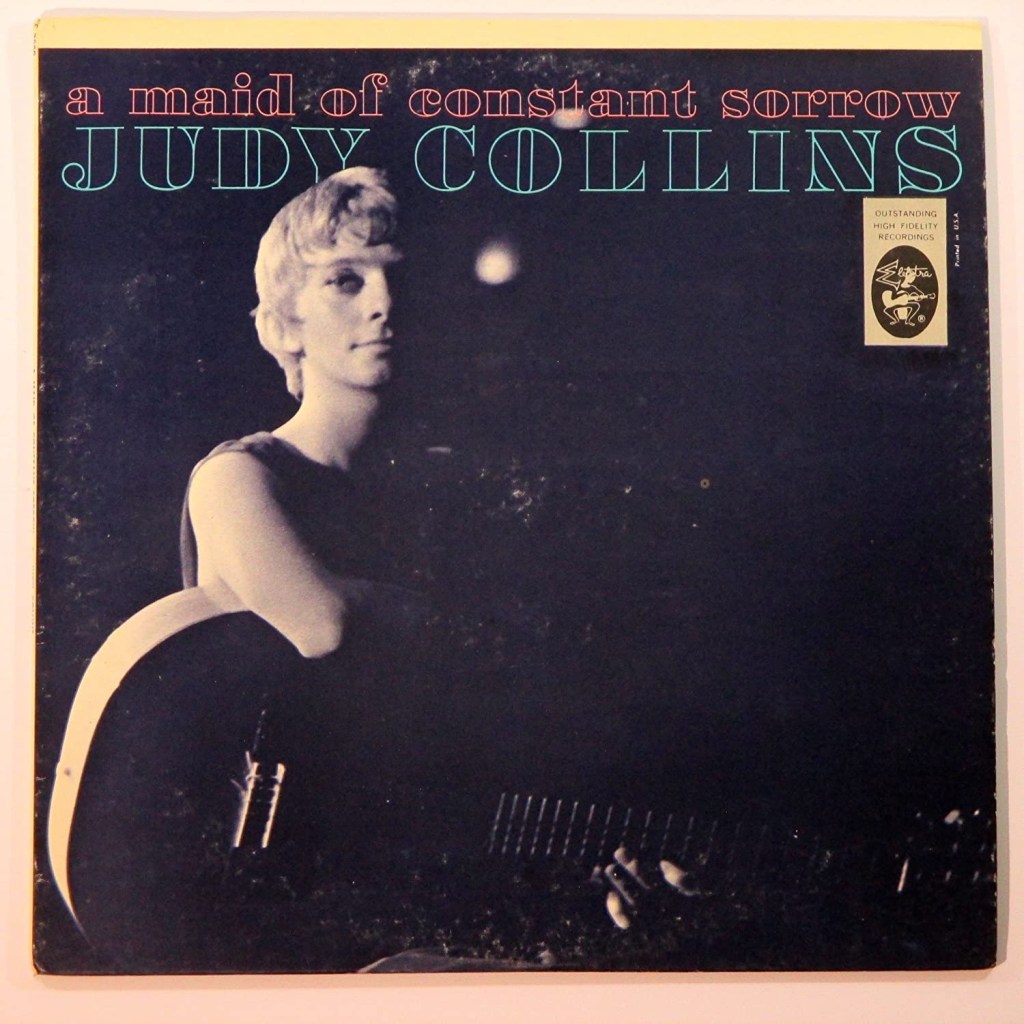
Genre: Folk
Released November 1961
Judy Collins’ debut, A Maid of Constant Sorrow, is a beautiful record of stunning purity.
It opens with the title track, A Maid of Constant Sorrow, a variation on A Man of Constant Sorrow, a song with obscure origins but was brought to mainstream public attention by The Stanley Brothers. I was fortunate enough to see Ralph Stanley live but I don’t remember if he played it or not. Many artists have recorded variations of the song but it probably reached the most people through the O Brother, Where Art Thou? soundtrack. The movie grossed $72 million at the box office and the soundtrack sold over nine million copies, one of which was bought by me. It’s also on Bob Dylan’s debut which is another of one the very few older releases I’ve reviewed on this blog. Collins version is very straightforward and hangs its hat on her astonishing beautiful voice. It’s one of the classic, if overlooked, versions.
The second track is The Prickilie Bush, also known as The Maid Freed from the Gallows. The Wikipedia page claims the song is centuries old. Perhaps the most famous version is Gallows Pole off of Led Zeppelin III. It’s also featured on a fantastic release a lot of people might not know about: No Quarter: Jimmy Page and Robert Plant Unledded. The song is about a person waiting to be hanged and various friends and family who come with or more commonly without gold or silver to pay off the condemned fines or to bribe the executioner. In the more unsavory versions the executioner is successfully bribed with sexual favors. In Collins’ version, her “darling” comes with gold and silver and she ends up alive and swearing off her nefarious ways. Her presentation is very well-postured proud liberal (if you’ve ever been to the art house cinema and sat behind a granola type you know what I mean) clearly influenced by the stylings of the great Pete Seeger.
The third track is one of the best versions of Wild Mountain Thyme ever sang. The verses are a cappella and the chorus has a sparse banjo accompaniment. Her voice on this track is so great you can feel it in your heart. The sorrow. Also, this song which dates back at least two centuries, contains a large part of the melodic structure for The Pogues’ A Pair of Brown Eyes which is simply put, with no hyperbole, one of the greatest songs ever written.
The fourth track is Tim Evans written by communist activist Ewan MacColl. Tim Evans is the true story of a man whose wife and infant daughter were murdered by the serial killer, John Christie. Unfortunately for Evans, he was falsely accused, convicted, and hanged for the crimes he didn’t commit. Evans was 25 when he was wrongly executed.
The fifth track is A Sailor’s Life, a folk song that dates back to the 1700’s. The song is about a woman who loves a sailor who drowns. The most famous version is probably the one on Fairport Convention’s album Unhalfbricking that came out about eight years later. It’s 11 minutes long and enjoys the beautiful voice of Sandy Denny.
The sixth track is an Irish fight song about brave but unsuccessful soldiers titled The Bold Fenian Men. Below is an early recording of the song from 1955.
The seventh song or the first song on side 2 of the long play is an anti-war song about a soldier’s death called Wars of Germany. It’s a traditional folk song. I don’t know much about the history of the song. If you have any information about it please comment below.
The eighth song is O Daddy Be Gay. Also listed as a traditional song with little else to be learned online about it, it’s an amusing song about the devil stealing a man’s wife and carrying her to hell only to decide she’s more trouble than she’s worth, even on fire apparently, so he brings her back to her Gay Daddy husband.
The ninth song is I Know Where I’m Going. The best version of this song is Burl Ives’ 1941 version off Okeh Presents the Wayfaring Stranger.
The tenth song is John Riley a traditional folk song about a persistent suitor only to be rejected again and again despite his collections of what if scenarios where the waited for John Riley has met his end during his seven year hiatus. But alas the woman’s loyalty pays off as the persistent suitor turns out to be the long lost John Riley himself! Mr. Riley picks her up in his strong arm and kisses her three times! The music on this one is dense guitar and banjo breaking with the general minimalist approach to the record.
The eleventh song is Pretty Saro. More than any other track on this record this sound of this song will continue to echo throughout her career. Wikipedia says Sam Amidon’s song Saro off the incredible All is Well record is the same song but they sound different and have different lyrics so I don’t know about that. They’re both extraordinarily beautiful songs, however.
The twelfth and final track is The Rising of the Moon which is another tribute to Fenian warriors who died in an unsuccessful campaign.
 Warmth Highest